
Beyond Heinlein: A Reading List for Philosophical Sci-Fi Fans
What to read after Stranger in a Strange Land“To encounter the ‘Other’ is to redefine the ‘Self’.”
If the philosophical provocations and social subversions of Robert A. Heinlein’s Stranger in a Strange Land left you questioning the very fabric of human identity, religion, and culture, you are ready for the next level of speculative fiction.
Heinlein’s masterpiece did more than tell a story about an outsider; it used the “alien” as a mirror to reflect the absurdities, the potential, and the terrifying evolutions of the human race. It challenged the reader to consider: What defines us? How do we communicate with the truly “Other”? And what happens to our society when our biological or mental boundaries are breached?
The books listed below follow those same ambitious threads. Whether through the lens of first contact with incomprehensible intelligences, the psychological toll of altered consciousness, or the grand-scale evolution of human civilization, these works share Heinlein’s penchant for asking the “big questions.”
From the sweeping sociopolitical epics of Frank Herbert and Isaac Asimov to the mind-bending ontological shifts of Philip K. Dick and Stanisław Lem, this collection offers a journey through the most profound frontiers of science fiction—where the greatest mystery is not the vastness of space, but the enigma of the human mind.
Solaris
“We are searching for something that is not there, or something that is more than we can bear.“
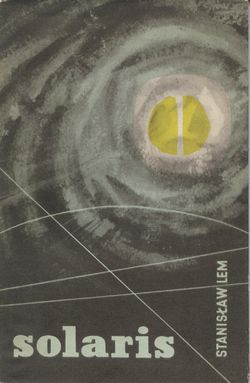
Deep within a research station orbiting a distant, enigmatic world, scientists struggle to comprehend an impossible intelligence. The planet is entirely shrouded by a sentient, living ocean that defies every law of known biology. As researchers attempt to study this cosmic anomaly, the ocean begins to reach back, manifesting physical embodiments of their most profound traumas and repressed memories. These “visitors” force the crew to confront the ghosts of their pasts, blurring the line between scientific discovery and psychological torment. It is a haunting meditation on the limits of human communication and the terrifying possibility that we may never truly understand the universe we seek to master.
Author: Stanisław Lem
Published: 1961 (MON), English translation 1970 (Walker)
Buy from: Amazon | Books-A-Million | Bookshop.org
Childhood's End
“Humanity’s greatest era is also its final one.“
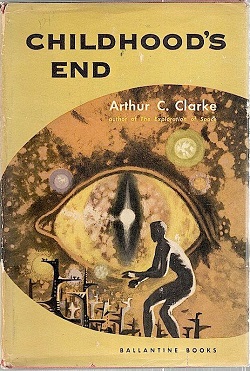
When colossal, mysterious spacecraft descend upon Earth’s cities, humanity enters an era of unprecedented peace. Guided by the enigmatic “Overlords”, wars, hunger, and poverty vanish, replaced by a global utopia. Yet, beneath this tranquil surface, a cosmic transformation is brewing. As the human race flourishes under alien supervision, the next generation begins to undergo a terrifyingly sublime metamorphosis. Children are evolving into something transcendent, shedding their physical forms to join a vast, collective consciousness. This profound science fiction epic explores the ultimate destiny of mankind, questioning if the price of reaching the next stage of existence is the total extinction of the individual.
Author: Arthur C. Clarke
Published: 1953 (Ballantine Books)
Buy from: Amazon | Books-A-Million | Bookshop.org
Ubik
“Ubik is cheaper today. The price of cheese has gone up, too. That's inflation for you.“
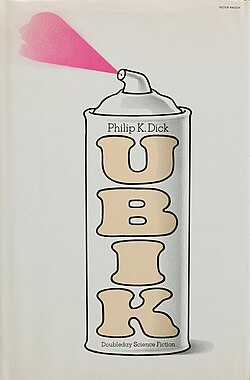
Set in a distant future where genetic alteration has made telepathy and psychometry commonplace, Ubik follows a team of elite operatives at a dangerous corporate intelligence agency. The plot begins with a assassination attempt on lead telepath Glen Runciter, resulting in his apparent death. Runciter's consciousness exists in a limbo between life and death, observing his colleagues through their own psychic pain—and through increasingly disturbing reality shifts. Expensive appliances deteriorate into antiques; skyscrapers dissolve into rubble; people fragment and fade. These regressions are consistently reversed by the appearance of Ubik, a mysterious product that seems to halt entropy. The novel's brilliant twist reveals that a parallel universe invading our own is gradually rendering our reality obsolete, and that what we perceive as reality shifts mirror the destruction of our existence. Dick explores perception, reality, corporate capitalism, and afterlife through a thriller framework, culminating in a shocking scene where the boundaries between realities fracture as Ubik itself shifts between versions—a metafictional commentary on the instability of narrative and reality itself.
Author: Philip K. Dick
Published: 1969 (Doubleday)
Buy from: Amazon | Books-A-Million | Bookshop.org
Dune
“I must not fear. Fear is the mind-killer. Fear is the little-death that brings total obliteration. I will face my fear. I will permit it to pass over me and through me.“

In the vast, unforgiving expanse of the desert planet Arrakis, young Paul Atreides finds himself caught in a lethal web of political maneuvering. As his noble house assumes control of the universe's most precious resource—the life-extending spice melange—they become targets for ancient rivalries and treacherous betrayals. Amidst shifting sands and gargantuan sandworms, Paul must navigate a landscape of religious prophecy and complex ecological struggle. This sweeping epic explores the heavy price of power, the evolution of human consciousness, and the fragile balance of a galaxy shaped by greed and destiny. It is a profound masterpiece of science fiction.
Author: Frank Herbert
Published: 1965 (Chilton Books)
Buy from: Amazon | Books-A-Million | Bookshop.org
Foundation series
“The history of an empire is not written by the decisions of emperors, but by the interactions of millions. And when you quantify the desires, fears, and actions of millions, patterns emerge, constants that cannot be escaped no matter how brilliant the strategist.“
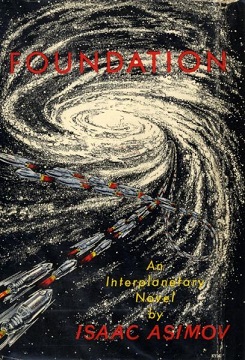
Seldon's psychohistory predicts thirty millennia of regression, so he establishes small colonies strategically positioned to shorten the recovery period to mere centuries. As the Foundation accumulates technical knowledge while avoiding political entanglements, they gradually accumulate power amid galactic decay. Asimov traces this mathematical prediction through multiple volumes, following how Seldon's pre-planned interventions shape galactic evolution through interpreters who access his holographic warnings, ultimately revealing that mathematical determinism governs civilization's trajectory regardless of individual agency or dramatic conflicts.
Author: Isaac Asimov
Published: 1951 - 1953 (Gnome Press), 1982 - 1993 (Doubleday)
Buy from: Amazon | Books-A-Million | Bookshop.org
The Mote in God's Eye
“To understand them is to fear them.“
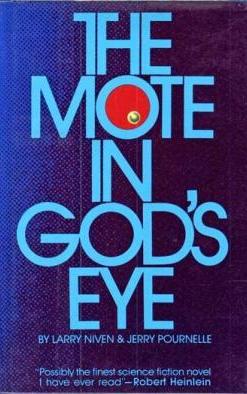
Deep within the galaxy, a mysterious star hides a secret that could reshape the future of mankind. When human explorers encounter a highly advanced alien civilization, they anticipate a milestone of peaceful diplomacy. However, they quickly realize that the Moties operate under biological imperatives far beyond human comprehension. As scientific curiosity clashes with military caution, a chilling reality about the aliens' evolutionary drive begins to unfold. This seminal masterpiece of hard science fiction masterfully explores the complexities of first contact, questioning whether two vastly different species can ever truly understand one another before it is too late.
Author: Larry Niven, Jerry Pournelle
Published: 1974 (Simon & Schuster)
Buy from: Amazon | Books-A-Million | Bookshop.org
The Left Hand of Darkness
“It's no use saying that men are bigger than women, or that they are stronger, or that they are smarter. Those are physical facts. The interesting question is whether a person's masculinity or femininity determines his or her soul.“
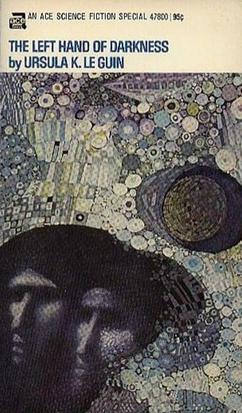
Gendaal diplomat Genly Ai arrives on Gonen (Winter), a planet whose inhabitants are hermaphrodites without fixed gender or national identity. Genly's diplomatic mission to incorporate Winter into a universal federation becomes entangled with murder, betrayal, and a profound attachment to the courtier Estraven. The story moves between political intrigue and intimate psychological examination, exploring what it means to encounter difference that refuses the categories we possess. Winter has no “home” or “other”—no masculine/feminine divide, no public/private separation, and no way to comprehend a diplomat who possesses fixed identity. As Genly becomes stranded and allies with Estraven on a desperate crossing of Winter's continent, the novel interrogates whether understanding across fundamental difference is possible, or whether we can only ever approximate it.
Author: Ursula K. Le Guin
Published: 1969 (Ace Books)
Buy from: Amazon | Books-A-Million | Bookshop.org
Brave New World
“I don't want comfort. I want God, I want poetry, I want real danger, I want freedom, I want goodness. I want sin.“
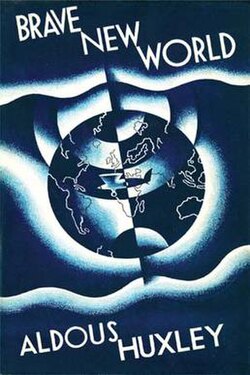
In a future where stability is the ultimate goal, humanity has traded freedom for comfort. In this highly controlled World State, citizens are genetically engineered into rigid social castes and conditioned from birth to love their servitude. Happiness is mandated through the consumption of soma, a drug that numbs any hint of discontent. However, the arrival of an outsider from a primitive reservation threatens this perfect equilibrium. This chilling masterpiece explores the terrifying cost of a painless existence, questioning whether a life without suffering is truly worth living if it means sacrificing the very essence of what makes us human.
Author: Aldous Huxley
Published: 1932 (Chatto & Windus)
Buy from: Amazon | Books-A-Million | Bookshop.org
Flowers for Algernon
“Intelligence is one thing, but happiness is another.“

Driven by a desperate desire to learn, Charlie Gordon undergoes an experimental surgical procedure designed to artificially boost his intelligence, modeled after a successful operation on a laboratory mouse named Algernon. As Charlie’s intellect skyrockets, he discovers a world of complex emotions and painful social truths previously hidden from him. Yet, his brilliant ascent is shadowed by a looming dread. As Algernon begins to experience a tragic cognitive decline, Charlie is forced to confront the terrifying possibility that his own newfound genius is merely a fleeting miracle. This profound, heartbreaking narrative explores the ethics of science and the fragile, beautiful nature of human identity.
Author: Daniel Keyes
Published: 1966 (Harcourt)
Buy from: Amazon | Books-A-Million | Bookshop.org
Blindsight
“Intelligence is a tool. Consciousness is a burden.“
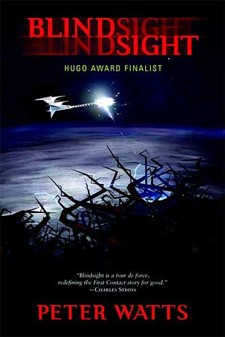
Deep in the void of space, a crew of genetically modified specialists is dispatched to investigate a mysterious signal from the edge of the solar system. Led by a linguist with profound neurological gaps, this team of post-humans—including a reconstituted vampire and a multi-bodied cyborg—confronts an alien intelligence that defies all human comprehension. As they encounter the “Scramblers”, the fundamental boundaries between intelligence and consciousness begin to dissolve. Peter Watts delivers a haunting, hard science fiction masterpiece that challenges the very necessity of self-awareness, forcing a terrifying question: is sentience an evolutionary advantage, or merely a fatal flaw in a universe of mindless, hyper-intelligent predators?
Author: Peter Watts
Published: 2006 (Tor Books)
Buy from: Amazon | Books-A-Million | Bookshop.org